RoboCup-2002
Middle-Size Robot League
FIFA Laws and RoboCup Modifications

|
RoboCup-2002Middle-Size Robot LeagueFIFA Laws and RoboCup Modifications |
|
Note: Numberings below level of laws were added for easier reference.
The field of play must be rectangular.
The length of the touch line must be greater than the length of the goal line.
Length: minimum 90 m (100 yds), maximum 120 m (130 yds)
Width: minimum 45 m (50 yds), maximum 90 m (100 yds)
Length: minimum 100 m (110 yds), maximum 110 m (120 yds)
Width: minimum 64 m (70 yds), maximum 75 m (80 yds)
The field of play is marked with lines. These lines belong to the areas of which they are boundaries.
The two longer boundary lines are called touch lines. The two shorter lines are called goal lines.
All lines are not more than 12 cm (5 ins) wide.
The field of play is divided into two halves by a halfway line.
The centre mark is indicated at the midpoint of the halfway line. A circle with a radius of 9.15 m (10 yds) is marked around it.
A goal area is defined at each end of the field as follows:
Two lines are drawn at right angles to the goal line, 5.5 m (6 yds) from the inside of each goalpost. These lines extend into the field of play for a distance of 5.5 m (6 yds) and are joined by a line drawn parallel with the goal line. The area bounded by these lines and the goal line is the goal area.
A penalty area is defined at each end of the field as follows:
Two lines are drawn at right angles to the goal line, 16.5 m (18 yds) from the inside of each goalpost. These lines extend into the field of play for a distance of 16.5 m (18 yds) and are joined by a line drawn parallel with the goal line. The area bounded by these lines and the goal line is the penalty area.
Within each penalty area a penalty mark is made 11 m (12 yds) from the midpoint between the goalposts and equidistant to them. An arc of a circle with a radius of 9.15 m (10 yds) from each penalty mark is drawn outside the penalty area.
A flagpost, not less than 1.5 m (5 ft) high, with a non-pointed top and a flag is placed at each corner.
Flagposts may also be placed at each end of the halfway line, not less than 1 m (1 yd) outside the touch line.
A quarter circle with a radius of 1 m (1 yd) from each corner flagpost is drawn inside the field of play.
Goals must be placed on the centre of each goal line.
They consist of two upright posts equidistant from the corner flagposts and joined at the top by a horizontal crossbar.
The distance between the posts is 7.32 m (8 yds) and the distance from the lower edge of the crossbar to the ground is 2.44 m (8 ft).
Both goalposts and the crossbar have the same width and depth which do not exceed 12 cm (5 ins). The goal lines are the same width as that of the goalposts and the crossbar. Nets may be attached to the goals and the ground behind the goal, provided that they are properly supported and do not interfere with the goalkeeper.
The goalposts and crossbars must be white.
Goals must be anchored securely to the ground. Portable goals may only be used if they satisfy this requirement.
|
RoboCup Changes and Comments |
| The Field: |
|
| RC-1-1: Dimensions |
Length: minimum 8 m, maximum 10 m |
| RC-1-2: Field Markings |
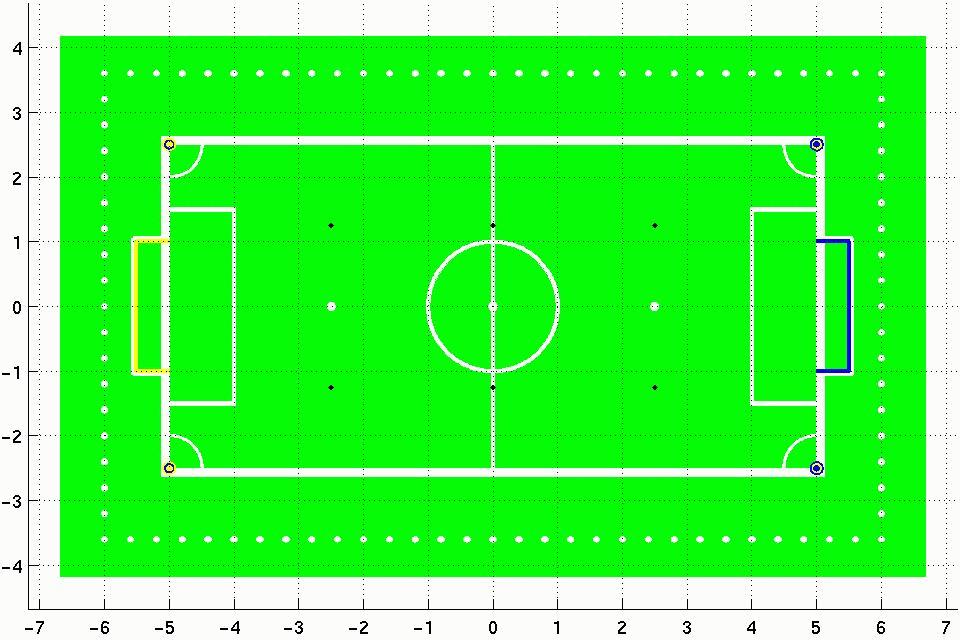
For RoboCup, the radius of the centre circle is 1 m. Extra markings for fields used in RoboCup are defined in clause RC-1-2-2. Clause RC-1-2-3 imposes restrictions on the surface used in RoboCup fields. Clause RC-1-2-4 imposes restrictions on the lighting present on RoboCup fields. |
| RC-1-2-1: Walls |
There should be NO wall around the playing area of the field. The border white line should be 12.5 cm thick. Outside the border line the robots should be able to move around. To sort out the safety problems, there is some device, such as a net, poles, or a thick pipe all around the field (1 meter away from the border line). This device is all around the field and would prevent the robots from going outside. |
| RC-1-2-2: Extra Markings |
The field used in RoboCup has 7 markings used for game restart. In addition to the centre marking, 6 extra spots on the field, marked with a black colour, will be used for that purpose. The penalty marks are not used for game restarts, unless a penalty was called by the referee. The positions of the six extra markers are specified in the field drawing above. |
| RC-1-2-3: Surface |
The color of the field surface must be green. Choosing a material for the floor is the responsibility of the local organizers of an event. It is recommended that organizers distribute samples of the floor prior to an event. |
| RC-1-2-4: Lighting |
Light sources will be hung over the field. The brightness of the field will be adjusted between 500 and 1500 lux. |
| RC-1-3: The Goal Area: |
A goal area is defined at each end of the field as follows: Two lines are drawn at right angles to the goal line, 0.5 m from the inside of each goalpost. These lines extend into the field of play for a distance of 1 m and are joined by a line drawn parallel with the goal line. The area bounded by these lines and the goal line is the goal area. |
| RC-1-4: The Penalty Area: |
The penalty area in RoboCup is the same as the goal area. Whenever FIFA rules refer to the penalty area, the RoboCup goal area is to substituted instead. For each penalty area a penalty mark is made 2 m from the midpoint between the goalposts and equidistant to them. |
| RC-1-5: Flagposts: |
Instead of flagposts, a cylinder with a diameter of 20 cm, 90 cm heigh, is placed on the corners of the field. The center of the cylinder is at the corner point. The cylinder should be painted in the same colour as the goal at its side of the field with the exception of 1/3 of the area at the center of the cylinder which has the colour of the opposite goal. A white quarter circle with a radius of 50cm from each corner post center is pasted inside the field of play. |
| RC 1-6: The Goals: |
For RoboCup, the distance between the goalposts is 2 m, and the distance between the lower edge of the crossbar and the ground is 0.9 m. The depth of the goal is at least 0.4 m. A wall may be placed around and behind the goal. Tournament regulations will define texture and color of the walls behind the goals. |
|
RoboCup Changes and Comments |
| RC Decision 3: |
FIFA decision 3 applies to RoboCup with the exception that markings, logo, and advertisement may be allowed above the height of 50 cm and above the goals. |
| RC Decision 4: |
FIFA decision 4 applies to RoboCup with the exception specified in RC Decision 3. |
| RC Decision 5: |
FIFA decision 5 does currently not apply to RoboCup. |
The ball is:
If the ball bursts or becomes defective during the course of a match:
If the ball bursts or becomes defective whilst not in play at a kick-off, goal kick, corner kick, free kick, penalty kick or throw-in:
The ball may not be changed during the match without the authority of the referee.
|
RoboCup Changes and Comments |
| RC-2-1: Qualities and Measures |
The ball for middle size league is a FIFA standard size 5 football. The color is orange. 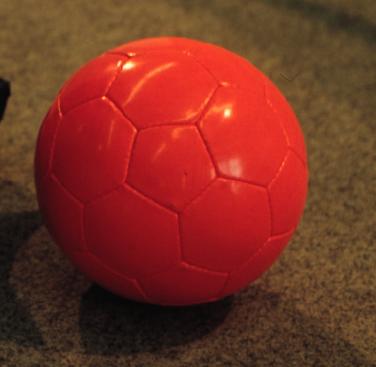 |
In competition matches, only footballs which meet the minimum technical requirements stipulated in Law 2 are permitted for use.
In FIFA competition matches, and in competition matches organised under the auspices of the confederations, acceptance of a football for use is conditional upon the football bearing one of the following three designations:
the official "FIFA APPROVED" logo,
or
the official "FIFA INSPECTED" logo,
or
the reference "INTERNATIONAL MATCHBALL STANDARD"
Such a designation on a football indicates that it has been tested officially and found to be in compliance with specific technical requirements, different for each category and additional to the minimum specifications stipulated in Law 2. The list of the additional requirements specific to each of the respective categories must be approved by the International F.A. Board. The institutes conducting the tests are subject to the approval of FIFA.
National association competitions may require the use of balls bearing any one of these three designations.
In all other matches the ball used must satisfy the requirements of Law 2.
|
RoboCup Changes and Comments |
| RC Decision 2: |
The organizing committee of a tournament is responsible for approving the balls to be used, including any kind advertisement, logo, or emblem on the ball. |
A match is played by two teams, each consisting of not more than eleven players, one of whom is the goalkeeper. A match may not start if either team consists of fewer than seven players.
Up to a maximum of three substitutes may be used in any match played in an official competition organised under the auspices of FIFA, the confederations or the national associations.
The rules of the competition must state how many substitutes may be nominated, from three up to a maximum of seven.
In other matches, up to five substitutes may be used, provided that:
If the referee is not informed, or if no agreement is reached before the start of the match, no more than three substitutes are allowed.
In all matches the names of the substitutes must be given to the referee prior to the start of the match. Substitutes not so named may not take part in the match.
To replace a player by a substitute, the following conditions must be observed:
Any of the other players may change places with the goalkeeper, provided that:
If a substitute enters the field of play without the referee's permission:
If a player changes places with the goalkeeper without the referee's permission before the change is made:
For any other infringements of this Law:
If play is stopped by the referee to administer a caution:
A player who has been sent off before the kick-off may be replaced only by one of the named substitutes.
A named substitute who has been sent off, either before the kick-off or after play has started, may not be replaced.
|
RoboCup Changes and Comments |
| RC-3-1: Players |
A match is played by two teams, each consisting of not more than four players, one of whom is the goalkeeper. A match may not start if either team consists of fewer than two players. |
| RC-3-5: Substitution Procedure |
Conditions 3-5-2 is replaced by: A substitute only enters the field of play after the player being replaced has left Conditions 3-5-3 is replaced by: A substitute only enters the field of play after receiving a signal from the referee or during a stoppage in the match Conditions 3-5-5 is replaced by: From that moment, the substitute becomes a player and the player it has replaced becomes a substitute Condition 3-5-6 does not apply to RoboCup, i.e. a player leaving the field during a substitution may come back during a later substitution. |
| RC-3-7: Infringements/Sanctions |
If a substitute enters the field of play without the referee's permission:
|
|
RoboCup Changes and Comments |
| RC Decision 1: |
In RoboCup matches, the minimum number of players in a team must be one. If for whatever reason either team has not a single player on the field, the match is discontinued. The organizing committee of a tournament will decide on appropriate measures. |
A player must not use equipment or wear anything which is dangerous to himself or another player (including any kind of jewellery).
The basic compulsory equipment of a player is:
For any infringement of this Law:
A player who has been required to leave the field of play because of an infringement of this Law and who enters (or re-enters) the field of play without the referee's permission is cautioned and shown the yellow card.
If play is stopped by the referee to administer a caution:
|
RoboCup Changes and Comments |
| RC-4-1: Safety |
Additional requirements to be met by players have to be specified in the RoboCup Laws. |
| RC-4-2: Basic Equipment |
This clause does not apply to RoboCup. Design requirements to be met by players have to be specified in the RoboCup Laws. |
| RC-4-3: Shinguards |
This does not apply to RoboCup. |
| RC-4-4: Goalkeepers |
The goalkeeper must wear some marker for identification. The RoboCup laws or tournament regulations have to provide specifications for these markings. |
Each match is controlled by a referee who has full authority to enforce the Laws of the Game in connection with the match to which he has been appointed.
The Referee:
The decisions of the referee regarding facts connected with play are final.
The referee may only change a decision on realising that it is incorrect or, at his discretion, on the advice of an assistant referee, provided that he has not restarted play.
|
RoboCup Changes and Comments |
| RC-5-2: Duties |
In RoboCup, some referee duties like time keeping and keeping a record of the match may be delegated to one of the assistant referees. |
A referee (or where applicable, an assistant referee or fourth official) is not held liable for:
any kind of injury suffered by a player, official or spectator
any damage to property of any kind
any other loss suffered by any individual, club, company, association or other body, which is due or which may be due to any decision which he may take under the terms of the Laws of the Game or in respect of the normal procedures required to hold, play and control a match.
This may include:
In tournaments or competitions where a fourth official is appointed, his role and duties must be in accordance with the guidelines approved by the International F.A. Board.
Facts connected with play shall include whether a goal is scored or not and the result of the match.
Two assistant referees are appointed whose duties, subject to the decision of the referee, are to indicate:
The assistant referees also assist the referee to control the match in accordance with the Laws of the Game.
In the event of undue interference or improper conduct, the referee will relieve an assistant referee of his duties and make a report to the appropriate authorities.
|
RoboCup Changes and Comments |
| RC-6-1: Duties |
In RoboCup, one or more assistants may be appointed for a match. The recommendation is to have three assistant referees. One of the assistant referees should be responsible for time keeping and keeping a game record. The referee may assign assistant referees additional duties aside of those specified in the FIFA law. |
The match lasts two equal periods of 45 minutes, unless otherwise mutually agreed between the referee and the two participating teams. Any agreement to alter the periods of play (for example to reduce each half to 40 minutes because of insufficient light) must be made before the start of play and must comply with competition rules.
Players are entitled to an interval at half-time.
The half-time interval must not exceed 15 minutes.
Competition rules must state the duration of the half-time interval.
The duration of the half-time interval may be altered only with the consent of the referee.
Allowance is made in either period for all time lost through:
The allowance for time lost is at the discretion of the referee.
If a penalty kick has to be taken or retaken, the duration of either half is extended until the penalty kick is completed.
Competition rules may provide for two further equal periods to be played. The conditions of Law 8 will apply.
An abandoned match is replayed unless the competition rules provide otherwise.
|
RoboCup Changes and Comments |
| RC-7-1: Periods of Play |
The match lasts two equal periods of 10 minutes. The referee may extend the period of play at his discretion by up to 1 minute, if any delays happened during regular match time. The match must start not later than 15 minutes after scheduled match time. The referee can adjust(enlarge/shorten) the startup and break period depending on the situation. |
A coin is tossed and the team which wins the toss decides which goal it will attack in the first half of the match.
The other team takes the kick-off to start the match.
The team which wins the toss takes the kick-off to start the second half of the match.
In the second half of the match the teams change ends and attack the opposite goals.
A kick-off is a way of starting or restarting play:
A goal may be scored directly from the kick-off.
After a team scores a goal, the kick-off is taken by the other team.
8-4-1 If the kicker touches the ball a second time before it has touched another player:
8-4-2 For any other infringement of the kick-off procedure:
A dropped ball is a way of restarting the match after a temporary stoppage which becomes necessary, while the ball is in play, for any reason not mentioned elsewhere in the Laws of the Game.
The referee drops the ball at the place where it was located when play was stopped. *(see Law 8)
Play restarts when the ball touches the ground.
The ball is dropped again:
A free kick awarded to the defending team inside its own goal area is taken from any point within the goal area.
An indirect free kick awarded to the attacking team in its opponents' goal area is taken from the goal area line parallel to the goal line at the point nearest to where the infringement occurred.
A dropped ball to restart the match after play has been temporarily stopped inside the goal area takes place on the goal area line parallel to the goal line at the point nearest to where the ball was located when play was stopped.
|
RoboCup Changes and Comments |
| RC-8-2: Kick-off |
Clause 8-2 is extended as follows: all robots of a team are started and stopped via wireless communication from outside the field. Starting and stopping robots manually should be an exception and is only allowed after getting permission from the referee. |
| RC-8-3: Procedure (for kick-off) |
Clause 8-3-2 is changed as follows: The opponents of the team taking the kick-off are at least 1 m from the ball until it is in play. Clause 8-3-4 is extended as follows: If one or both of the teams in a match have permission to use a manual startup procedure, the referee gives a sequence of two signals with an interval of 10 seconds. Robot player's without remote start capability may be started on the field after the first signal. They may not move before the second signal was given by the referee. All human team members must leave the field of play immediately after the first signal and before the second signal. Clause 8-3-6 currently does not apply to RoboCup. Before kickoff, all robots of a team should move to their kickoff position inside the team's half autonomously. If a robot cannot move autonomously, it can be joysticked by remote control. If a robot gets stuck while moving back, a team member can help (i.e., move or rotate it a bit) resolving its situation. If a robot cannot move back to its starting position, it has to be picked up by a team member and placed on one of the following three positions inside the team's half: penalty marker, game restart marker to the left of the penalty marker, or game restart marker to the right of the penalty marker. The robot should anyway show to be able to move somehow. Before the kick-off, all robots must be in their own half (Clause 8-3-1) and outside the center circle. As soon as the referee starts the game, robots of both teams are allowed to move in the entire field, but the defending team cannot enter the centre circle until the ball is in play. The ball is in play when it is touched and moved by the attacking team. If the ball isn't in play in 10 seconds after the start, the kick-off should be retaken, but assigned to the other team. If, before the ball is in play, a robot of the defending team enters the centre circle, a yellow card is shown to the infringing robot and the kick-off is retaken by the same team. On kickoff, the kicking robot can only score a goal after it completely left the center circle. If the attacking robot directly or indirectly (by hitting other players) scored while it was still partially inside the center circle, the goal will not be awarded and the game is restarted with the kickoff given to the same team again. |
| RC-8-4: Infringements/Sanctions (for kick-off) |
Clause 8-4-1 does currently not apply to RoboCup. If a human team member is still on the field after the referee has given the second signal, and the opposing team was taking the kick-off, and the player taking the kick-off has already kicked the ball in the direction of the goal, a penalty kick may be awarded to the team taking the kick-off. In all other cases, the kick-off is retaken. |
| RC-8-6: Procedure (for dropped ball) |
The referee places the ball on the nearest game restart point (see law 1 and RC-1-2-2). If this restart point is occupied by robots, the referee places the ball as close to the nearest restart point as possible. |
| RC-8-7: Infringements/Sanctions (for dropped ball) |
This does currently not apply to RoboCup. |
The ball is out of play when:
The ball is in play at all other times, including when:
A goal is scored when the whole of the ball passes over the goal line, between the goalposts and under the crossbar, provided that no infringement of the Laws of the Game has been committed previously by the team scoring the goal.
The team scoring the greater number of goals during a match is the winner. If both teams score an equal number of goals, or if no goals are scored, the match is drawn.
For matches ending in a draw, competition rules may state provisions involving extra time, or other procedures approved by the International F.A. Board to determine the winner of a match.
|
RoboCup Changes and Comments |
| RC-10-3: Competition Rules |
For matches ending in a draw, competition rules may state provisions involving extra time, or other procedures to determine the winner of a match. |
Click here to see text of the official FIFA law.
|
RoboCup Changes and Comments |
| Law 11: |
This law does currently not apply to RoboCup. |
Click here to see text of the official FIFA law.
|
RoboCup Changes and Comments |
| Law 12: |
This law does currently not apply to RoboCup. RoboCup laws have to specify rules for fouls and misconduct. |
Free kicks are either direct or indirect.
For both direct and indirect free kicks, the ball must be stationary when the kick is taken and the kicker does not touch the ball a second time until it has touched another player.
Signal
The referee indicates an indirect free kick by raising his arm above his head. He maintains his arm in that position until the kick has been taken and the ball has touched another player or goes out of play.
Ball Enters the Goal
A goal can be scored only if the ball subsequently touches another player before it enters the goal.
Free Kick Inside the Penalty Area
Direct or indirect free kick to the defending team:
Indirect free kick to the attacking team:
Free Kick Outside the Penalty Area
13-5-1 If, when a free kick is taken, an opponent is closer to the ball than the required distance:
13-5-2 If, when a free kick is taken by the defending team from inside its own penalty area, the ball is not kicked directly into play:
Free kick taken by a player other than the goalkeeper
13-5-3 If, after the ball is in play, the kicker touches the ball a second time (except with his hands) before it has touched another player:
13-5-4 If, after the ball is in play, the kicker deliberately handles the ball before it has touched another player:
Free kick taken by the goalkeeper
13-5-5 If, after the ball is in play, the goalkeeper touches the ball a second time (except with his hands), before it has touched another player:
13-5-6 If, after the ball is in play, the goalkeeper deliberately handles the ball before it has touched another player:
|
RoboCup Changes and Comments |
| RC-13-1: Types of Free Kicks |
In RoboCup, the kicker may touch the ball arbitrary many times after either a direct or indirect free kick. |
| RC-13-2: Direct Free Kick |
If a direct free kick is kicked directly into the team's own goal, a direct free kick from the centre of the field is awarded to the opposing team. |
| RC-13-3: Indirect Free Kick |
If an indirect free kick is kicked directly into the team's own goal, a direct free kick from the centre of the field is awarded to the opposing team. |
| RC-13-4: Position of Free Kick |
The distance of 2 m is to be observed whenever the FIFA law for free kicks specifies 9.15 m. |
| RC-13-5: Infringements/Sanctions |
Clauses 13-5-3 and 13-5-5 do currently not apply to RoboCup. |
A penalty kick is awarded against a team which commits one of the ten offences for which a direct free kick is awarded, inside its own penalty area and while the ball is in play.
A goal may be scored directly from a penalty kick.
Additional time is allowed for a penalty kick to be taken at the end of each half or at the end of periods of extra time.
The ball:
The player taking the penalty kick:
The defending goalkeeper:
The players other than the kicker are located:
When a penalty kick is taken during the normal course of play, or time has been extended at half-time or full time to allow a penalty kick to be taken or retaken, a goal is awarded if, before passing between the goalposts and under the crossbar:
14-4-1 If the referee gives the signal for a penalty kick to be taken and, before the ball is in play, one of the following situations occurs:
14-4-1-1 The player taking the penalty kick infringes the Laws of the Game:
14-4-1-2 The goalkeeper infringes the Laws of the Game:
14-4-1-3 A team-mate of the player taking the kick enters the penalty area or moves in front of or within 9.15 m (10 yds) of the penalty mark:
14-4-1-4 A team-mate of the goalkeeper enters the penalty area or moves in front of or within 9.15 m (10 yds) of the penalty mark:
14-4-1-5 A player of both the defending team and the attacking team infringe the Laws of the Game:
14-4-2 If, after the penalty kick has been taken:
14-4-2-1 The kicker touches the ball a second time (except with his hands) before it has touched another player:
14-4-2-2 The kicker deliberately handles the ball before it has touched another player:
14-4-2-3 The ball is touched by an outside agent as it moves forward:
14-4-2-4 The ball rebounds into the field of play from the goalkeeper, the crossbar or the goalposts, and is then touched by an outside agent:
|
RoboCup Changes and Comments |
| RC-14-1: Position of the Ball and the Players |
Before a penalty kick, all players other than the kicker and the goalkeeper have to move behind the centre line of the field, on the side opposite of the goal where the penalty kick takes place. The goalkeeper is positioned on the goal line first. Then, the player taking the penalty kick is positioned in the centre circle. The goal keeper may move before the kick is taken. |
| RC-14-3: Procedure |
The player taking the penalty kick may kick the ball arbitrary many times until the ball is touched by the goalkeeper for the first time. The kicker may not touch the ball again during a penalty shot once the goal keeper has touched the ball. The goalkeeper must remain within its goal area at all times during a penalty shot. A time limit of 60 seconds applies to a penalty shot. The time clock is started when the player taking the penalty shot starts to move. If a penalty shot is not executed within 60 seconds, it is called off by the referee after the time limit is exceeded. |
| RC-14-4: Infringements/ Sanctions |
Clause 14-4-1-3 is modified as follows: A team-mate of the player taking the kick moves across the centre line into the side of the field where the penalty shot takes place. The sanctions remain the same. Clause 14-4-1-4 is modified as follows: A team-mate of the goalkeeper moves across the centre line into the side of the field where the penalty shot takes place. The sanctions remain the same. Clause 14-4-2-1 is currently not applied in RoboCup. Clause 14-4-2-2 is currently not applied in RoboCup. |
Click here to see text of the official FIFA law.
|
RoboCup Changes and Comments |
| RC-15: |
A throw-in is a method of restarting play and a goal cannot be scored |
Click here to see text of the official FIFA law.
|
RoboCup Changes and Comments |
| RC-16: |
If the whole of the ball completely passes over the goal line, either
on |
Click here to see text of the official FIFA law.
|
RoboCup Changes and Comments |
| Law 17: |
This law does currently not apply to RoboCup. |